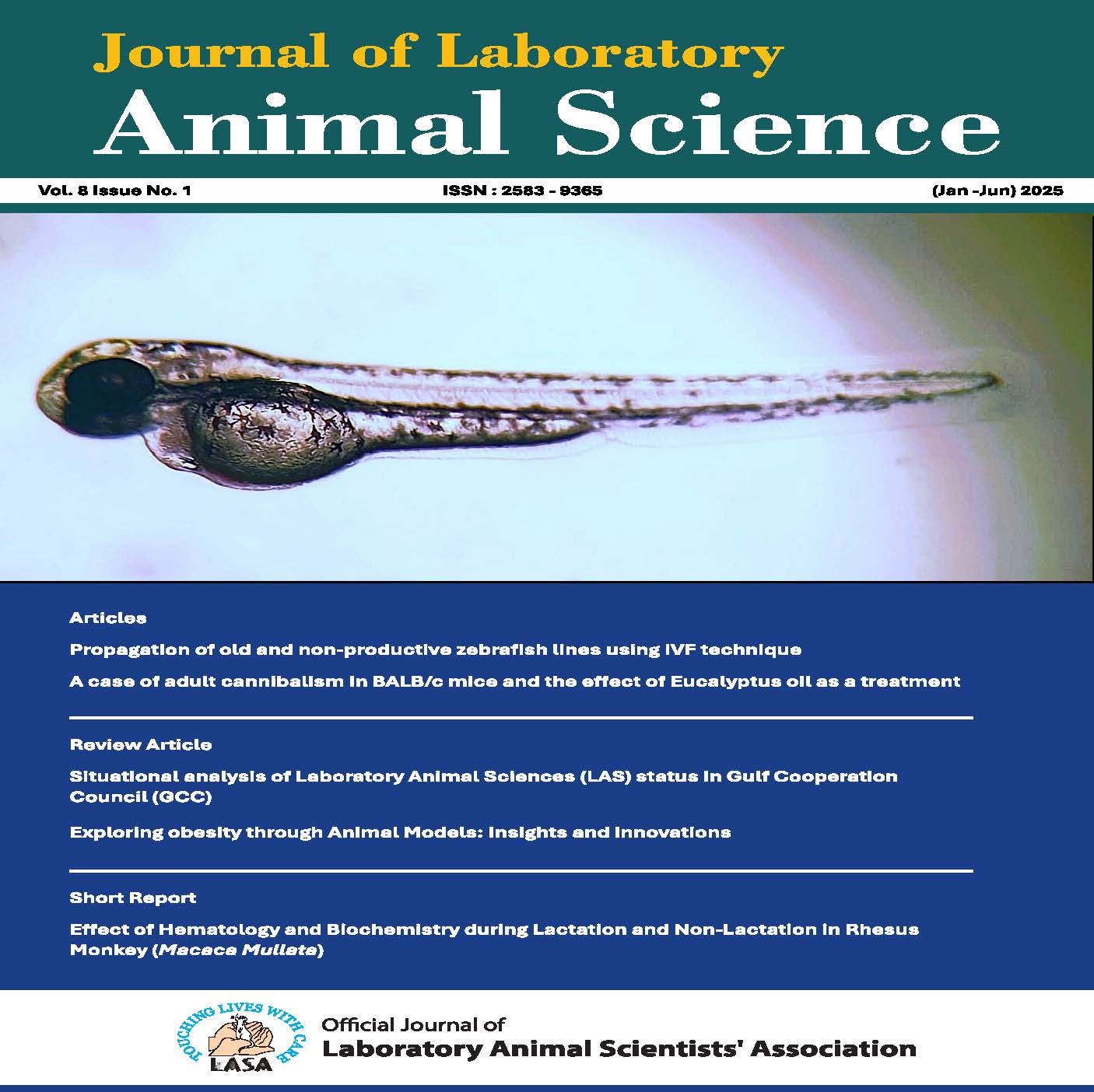
Instructions to Authors
Instructions to Authors
Open Access Statement
The Journal of Laboratory Animal Science (JLAS) provides immediate open access to its content, ensuring free and unlimited access to the full text of all published articles for readers worldwide.
1. Aims and Scope
The Journal of Laboratory Animal Science (JLAS) is the official journal of the Laboratory Animal Scientists’ Association (LASA), India. The journal is published biannually in English.
The journal publishes original articles, case reports, brief communications, letters to the editor, and review articles related to the use of animals in biomedical and veterinary research.
Topics include:
- Laboratory animal care and management
- Facility design and environmental enrichment
- Animal nutrition and health monitoring
- Pain management and welfare
- Genetics and transgenic animal models
- Animal models of disease
- Toxicological testing of agrochemicals and pharmaceuticals
- Animal facility management and training
- Regulations and ethical guidelines related to animal research
2. Editorial Policy
Ethical Approval
All research articles must be approved by the Institutional Animal Ethics Committee (IAEC). Authors must confirm that experimental procedures comply with accepted principles of animal use in biomedical research.
Housing conditions, environmental parameters, and management practices must be clearly described.
A statement confirming ethical approval from the relevant authority (IAEC / CPCSEA where applicable) must appear in the manuscript.
Permissions
Authors must obtain written permission to reproduce previously published material. Proper acknowledgement must be included in the manuscript.
Copyright
Authors of accepted manuscripts will be required to transfer copyright to the journal.
Peer Review
JLAS follows a single-blind peer review process. Manuscripts are initially screened by the Editor-in-Chief and then evaluated by at least two subject experts.
The Editor-in-Chief makes the final decision based on reviewer recommendations.
3. Types of Articles
Review Articles
Review articles are usually invited by the editorial board. These articles should not exceed 5500 words with approximately 75 references.
Original Articles
Original research articles should not exceed 4500 words and must include the following sections:
- Abstract
- Introduction
- Materials and Methods
- Results
- Discussion
- Acknowledgements
- References
Short Reports
Short communications and case reports should be less than 1500 words, with an abstract not exceeding 200 words and no more than two figures or tables.
4. Manuscript Submission
All manuscripts must include a cover letter addressed to the Editor-in-Chief confirming that:
- The work has not been previously published.
- The manuscript is not under consideration elsewhere.
- All authors have approved the submission.
- The corresponding author is authorized to communicate with the journal.
Manuscripts must be submitted through the online system:
5. Manuscript Preparation
Formatting
- Manuscripts should be double-spaced.
- Font: Times New Roman
- Font size: 12
- Headings should be clearly indicated.
Title Page
The title page should include:
- Full title of the manuscript
- Short running title (maximum six words)
- Names and affiliations of all authors
- Institution where work was performed
- Contact details of the corresponding author
Abstract
The abstract should not exceed 250 words (200 words for short reports).
Keywords: Up to five keywords should be provided.
Introduction
The introduction should describe the background, rationale, objectives, and significance of the study.
Materials and Methods
- Describe animals, procedures, equipment, and reagents.
- Provide statistical analysis methods.
- Include a statement regarding ethical approval.
- Use correct scientific nomenclature.
- Use SI units for measurements.
Results
- Present results clearly using tables and figures.
- Avoid repeating data already shown in figures or tables.
Discussion
- Summarize key findings.
- Interpret results in relation to previous research.
- Discuss study limitations and future directions.
Acknowledgements
Acknowledge individuals, institutions, and funding sources that contributed to the research.
References
All references must follow the APA Style (7th Edition).
Tables
- Tables should be numbered consecutively.
- Tables should be self-explanatory.
- No vertical lines should be used.
Figures
- Figures must be numbered consecutively.
- Each figure must have a legend.
- Acceptable formats: TIFF, JPEG, or PDF.
- Maximum file size: 50 MB.
Resolution Requirements
- 1200 dpi for line drawings
- 600 dpi for color figures
- 300 dpi for grayscale images
Abbreviations
Use only standard abbreviations. Avoid creating new abbreviations.
Units
All measurements must be expressed in SI units.
6. Proofs and e-prints
Proofs will be sent to the corresponding author as a PDF file via email. Authors should return corrections promptly and limit changes to essential corrections only.